iT
iTeamProject

Case Study

IT Governance and Service Management for a multi-vendor environment

An assessment and operating model redesign to clarify responsibilities, service levels, escalation paths and vendor control.

Industry
Services / Multi-vendor organization
Scale
Structured company with sites and external providers
Scope
IT Governance, SLAs, KPIs, escalation, reporting
Role
Assessment, operating model and coordination
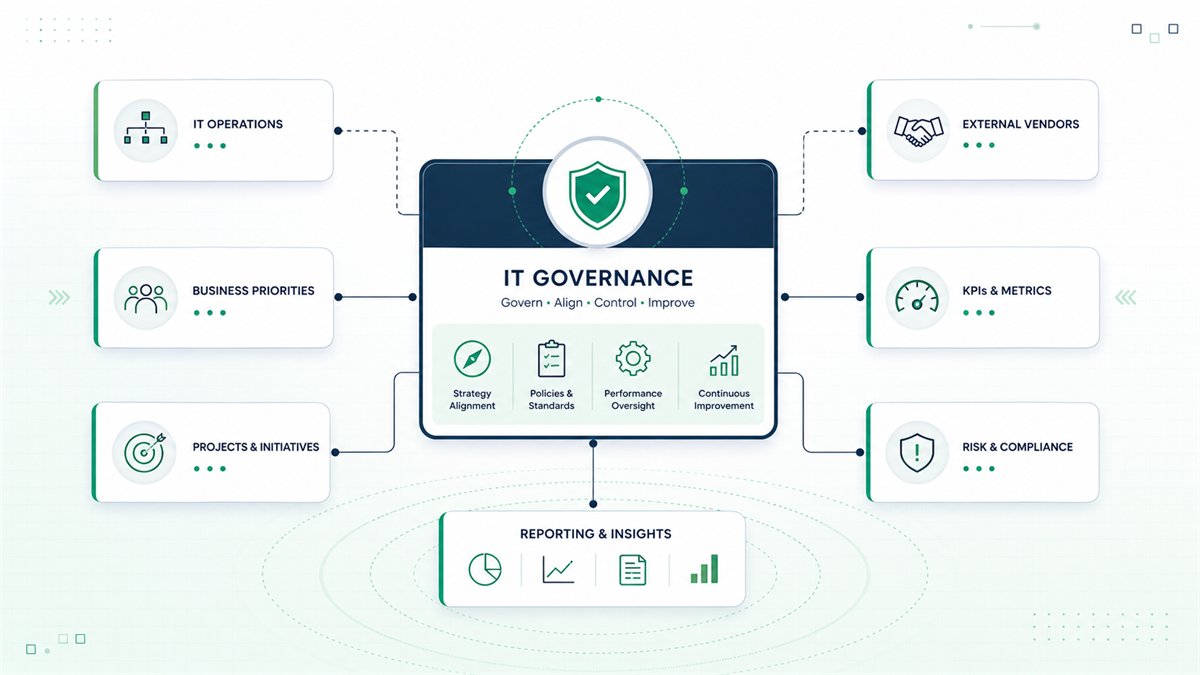
IT governance model diagram with business priorities, operations, vendors, KPIs and compliance

Results at a glance

The project turned a loosely formalized operating model into a clearer, measurable and better coordinated governance system.

Operational responsibilities
clearer
SLAs and KPIs
defined
Escalation paths
standardized
Reporting
monthly
Vendors
coordinated
Operational risks
tracked

Context

The company managed critical IT services through an ecosystem of internal teams, infrastructure providers, application partners and external managed services.

As the IT perimeter expanded, it became harder to understand who was responsible for each activity, which response times were expected and how service quality should be measured consistently.

Key issues

Operational work was often managed differently across providers, without a shared model for priorities, ownership, escalation and request closure.

Management had fragmented information: technical data, tickets and periodic updates were not always connected to indicators useful for governing cost, risk and service quality.

The challenge

The goal was to build a practical, sustainable and non-bureaucratic governance model that improved control without slowing down day-to-day operations.

The work had to align existing vendors, processes and internal responsibilities without forcing a full redesign of the IT organization.

The implemented solution

iTeamProject carried out an operational assessment of the main workstreams, mapping services, vendors, responsibilities, criticality levels, tools and escalation points.

Based on this assessment, a governance model was defined with clear roles, a responsibility matrix, priority criteria, essential SLAs/KPIs, a reporting calendar and recurring control routines.

The operating model

The new model introduced a clearer distinction between operations, service control, governance decisions and vendor coordination.

Recurring activities were structured into a simple cycle: request, ownership, execution, escalation when needed, closure, measurement and periodic review.

Reporting and control

Reporting was simplified into a set of indicators readable by management: volumes, priorities, response times, backlog, recurring incidents, corrective actions and open risks.

This shifted discussions from isolated operational issues to a more structured view of service quality, responsibilities and decisions to be made.

The role of iTeamProject

iTeamProject supported the assessment, model design, vendor workshops, KPI setup and definition of control routines.

The approach was intentionally pragmatic: a limited set of clear rules, explicit responsibilities and tools already compatible with the customer's operations.

Results

The customer gained better visibility over IT services, more orderly vendor management and a shared language for discussing priorities, service levels and risks.

The model reduced operational ambiguity and decision friction, creating a stronger foundation for future evolution in IT Service Management, audit and delivery control.

Do you want to make your IT ecosystem easier to govern?

We can analyze services, vendors, responsibilities and operating flows to build a governance model that is simple, measurable and sustainable.

Talk to iTeamProject